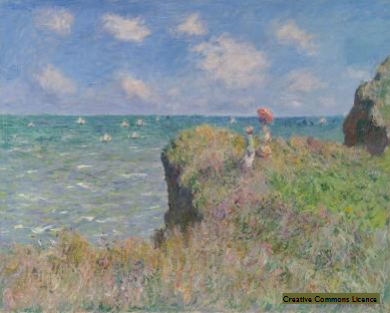
In 1882 Monet painted a series of
views of the English Channel at the
Normandy village of Pourville. An
example of these canvases was
considered in which Monet’s
mastery of light, reflection and
shadows on the surface of the sea,
and its movement, is so well
illustrated by his rapid brush
strokes.
Boat and Sea by Wilhelmina Barns-
Graham (1912-2004) shows how this artist created the form and magnitude of waves by an abstract device of lines.
Joan Eardley (1921-1963) painted the power of stormy seas by racing to the cliff tops of north east Scotland by train and motor scooter, with large boards and canvases, when bad weather was imminent.
We entered calmer waters with
the other two works considered.
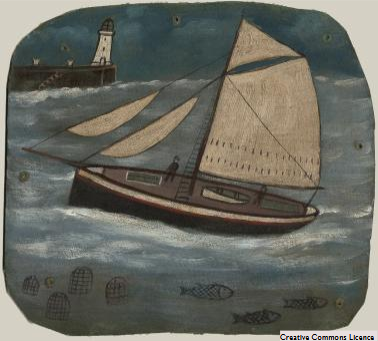
Alfred Wallace (1855-1942) the so
-called “Naïve” painter, was
championed by Ben Nicholson and
other artists who lived and worked
in St Ives. Beginning to paint at the
age of 70 using household paint on
odd pieces of cardboard, Alfred
depicted what he remembered.
The boats, and the bay in which
they are set, are accurately
detailed but bear little relationship
to each other or the landscape.
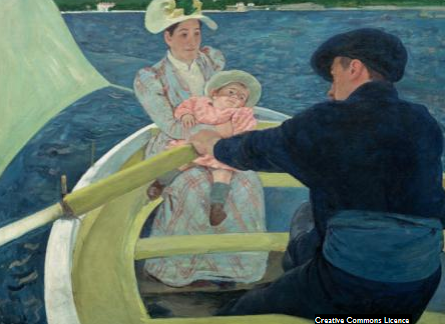
Boating Party by the American-born impressionist Mary Cassatt was painted in 1892 and is an unusual view of a woman holding a baby, and a man in a rowing boat. The viewpoint is from the stern with the man, in blue seafarer’s
clothes, occupying a large part of the picture and the woman facing us. The boat’s bow almost forms a frame for the mother and child, although the dress and facial expressions leave us guessing the relationship between the boat’s occupants.
The rendition of the woman’s clothing shows that magenta and blue pigments have been applied
when wet and allowed to mix on the canvas. The
overall composition is geometrically abstract, with
the pure forms of the sail and the outline of the boat
emphasised by the use of single colours.
It was with sorrow that we heard of the death, on the first of May, of former
group member Shirley Reid, for whom a memorial service was held at St
Lawrence Church Winchester on 15 June.
Shirley was an artist and teacher whose insights and experiences greatly
enriched our discussions. As a student she spent time in Church Cookham
while researching a thesis on Stanley Spencer. She stayed in William Lott’s
cottage (the house in Constable’s Haywain), and in the famous house, in
Highgate Cemetery, designed in 1969 by John Winter. She spoke about the
Bleau Globes acquired for Winchester Cathedral by Bishop Morley in the
17th century, which she knew from her time as a guide in the Kings and
Scribes exhibition. When visiting an exhibition featuring Picasso’s famous
Guernica, Shirley managed to look at the back of this large painting and see
how sections were fitted together. Shirley’s own skill was exemplified when
she showed us an ink sketch of a Maasai Warrior made when she was in the
Rift Valley. Her love of gardening and her religious faith inspired her as an
artist and teacher who believed the act of drawing is an active process, like
drawing water, and not merely recording what is in front of you.
Keith Hatter
| Status: | Active, open to new members |
| Leader: | |
| When: | Monthly on Thursday afternoons 4th Thursday in Month |
| Venue: | Members' Homes |
To email the Group Leader click on the link with his/her name. To obtain the Group Leaders telephone number access the Telephone Directory.